






◆ Fuchs Process Section (Section for Preparing Amylbenzene)
Benzene is conveyed to the water absorption kettle, where it is treated and then flows into the benzene dryer for further water absorption. It is then pumped into the Fuchs reactor as the reaction solvent. In the Fuchs reactor, the catalyst is added and the temperature is lowered. Meanwhile, alcohol is dripped into the reactor through the dropwise addition tank, and the Fuchs reaction is carried out by controlling the temperature. After the reaction is completed, hydrolysis and water washing are performed to separate the hydrolysis water and the organic phase. The organic phase is washed with hot water, and then the solvent is removed and benzene is recovered. The organic phase is further distilled, with the fore-run being recycled as the reaction solvent and the middle fraction being the product amylbenzene.
◆ Acylation Section (Preparation of Intermediate Ketonic Acid)
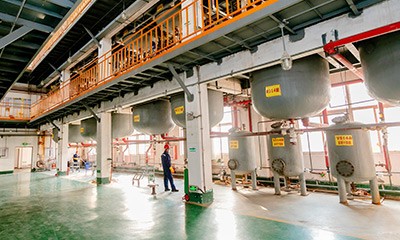
Chlorobenzene is fed into the chlorobenzene water absorption tank, and after treatment, it is dehydrated in the dryer and pumped into the acylation reactor as the reaction solvent. Isopentylbenzene and phthalic anhydride are added to the acylation reactor, and the acylation reaction is carried out with the addition of a catalyst. The exhaust gas is discharged through the tail gas treatment system. After the acylation reaction, the material is discharged into the acylation hydrolysis reactor for hydrolysis, and the aqueous phase and chlorobenzene phase are separated. After hot water washing, it enters the alkali dissolution reactor to react with flake caustic soda. The intermediate ketonic acid is converted into a sodium salt and dissolved in the aqueous phase, while the chlorobenzene phase is transferred to the solvent removal reactor for recovery. The aqueous phase enters the extraction reactor for extraction, and the aqueous phase is sent to the acid precipitation reactor, with petroleum ether being distilled for recovery. Dilute hydrochloric acid is added to the acid precipitation reactor for acid precipitation reaction. After the ketonic acid precipitates, it is filtered through a plate and frame filter press. The filtrate is sent to the sewage treatment, and the filter cake (ketonic acid) is dried and flows into the next process.
◆ Drying Process
The air is heated to 120℃ through a heat exchanger and then used in a fluidized bed dryer to dry the wet ketone acid material. The material is fed into the dryer through a screw feeder and then separated in a cyclone separator. The dried material is discharged from the bottom and flows into the next process, while the hot exhaust gas is discharged from the top, filtered through a bag filter to remove dust, and then sent to the VOCs tail gas treatment system.
◆ Cyclization Section
Sulfuric acid of a certain concentration is added to the dissolving tank, mixed with ketonic acid, preheated and then fed into the cyclization tubular reactor for reaction. After being metered, toluene is pumped into the water washing tank, mixed with water and cooled down. After the cyclization reaction, hydrolysis is carried out, and the aqueous phase is separated.
The toluene phase. After being washed with alkali, the oil phase enters the desolventization kettle for distillation to remove toluene, which is recovered and recycled. The distillation residue enters the freezing crystallization kettle to precipitate impurities. After filtration, the filtrate is collected and prepared for rectification.
◆ Distillation Section
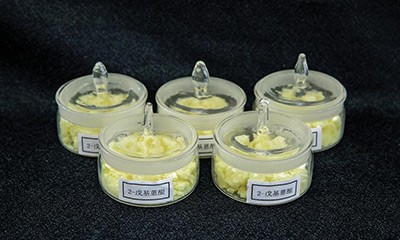
The filtrate from the cyclization section enters the distillation pot and is heated up to the temperature required by the process control. The initial distillate is collected in the initial distillate receiving tank. After the distillation of the initial distillate is completed, the middle distillate (i.e., the final product 2-pentylanthraquinone) is collected in the finished product receiving tank. After multiple batches of products are transferred to the mixing pot and mixed evenly and tested to be qualified, the products are packaged.
◆ Quality Control
Inspection and sampling of raw and auxiliary materials
Each batch of raw materials and auxiliary materials purchased must be strictly sampled and tested, and compared with the test report provided by the supplier. Only after confirmation of qualification can they be unloaded and stored in the warehouse.
A sample of each batch of raw materials is retained, along with the raw material test report of the same batch number (the sample is kept for one year).
Intermediate control in the product manufacturing process
All intermediate products of each batch in each section must be inspected. Unqualified products are strictly prohibited from flowing into the next process. Complete inspection records must be kept and the records should be preserved for more than three years.
Inspection of finished products
Each batch of finished products must be packaged (in barrels) only after passing the inspection. After the finished products solidify, samples must be taken from each batch for inspection and only after passing can they be stored in the warehouse.
Finished products are regularly sent to a third-party authoritative testing institution (Shanghai Institute of Organic Chemistry, Chinese Academy of Sciences) for benchmarking tests. Samples of each batch of finished products are retained for preservation, with a retention period of three years.