






2-pentylanthraquinone (CAS No. : 13936-21-5) is an organic compound with the molecular formula C19H18O2. It is mainly used as an efficient reaction carrier and catalyst in hydrogen peroxide production . Its high solubility and stability can increase the yield of hydrogen peroxide.
Chemical properties and structure
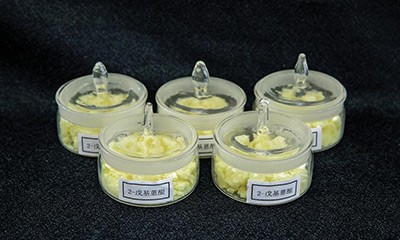
Physical properties : pale yellow crystals or powder, melting point 60-85°C, boiling point approximately 447°C, density 1.2 g/cm³, flash point 166.6°C.
Molecular structure : It belongs to anthraquinone derivatives, with an anthraquinone ring (9, 10-dione structure) at the core. The amyl group (-C5H11) is connected at position 2, and the tertiary amyl group structure (-C(CH3)3) enhances stability.
Chemical behavior : stable under acidic or oxidizing conditions, readily soluble in organic solvents (such as a mixture of trioctyl phosphate and xylene), and participates in hydrogenation-oxidation cycle reactions.
Core applications and industrial value
Hydrogen peroxide production :
· As the core carrier of the anthraquinone process, is prepared into a working solution with a solvent and hydrogen peroxide is generated through three steps of hydrogenation, oxidation and extraction.
· Compared with the traditional 2-ethylanthraquinone, it has a higher solubility, a 15%-20% increase in catalytic efficiency , significantly reduces production costs, and has been adopted by international enterprises such as BASF and DuPont.
Other fields : It is used as a pharmaceutical intermediate in organic synthesis, but its application is mainly concentrated in the hydrogen peroxide industry chain.
Synthesis and preparation methods
The mainstream process : it is produced from 2-(4' -tert-pentylbenzoyl) benzoic acid (ABB acid) as raw material through fuming sulfuric acid dehydration, with a yield of approximately 70%-80%.
Optimization technology : By using the phosphorus pentoxide/trifluoroacetic acid system and reacting in dichloroethane, the yield can be increased to 85.5% and the purity to 98.7%.
Purification key : activated carbon decolorization, distillation crystallization to remove tar-like impurities, ensuring industrial-grade purity (≥98%).